
Lium
GPU rental marketplace where independent providers list verified NVIDIA hosts, billed per second
Lium is a GPU rental marketplace built on Bittensor Subnet 51. Independent providers list whole NVIDIA hosts, from RTX 4090 and 5090 cards to A100, H100, H200, B200 and B300 machines. Validators check each node's hardware before it earns. Renters pay the provider's listed price per GPU-hour, billed per second with no minimum rental. Balances are topped up by card or crypto.
Pods start from the terminal with the lium.io CLI (lium up --gpu H100) or the web console. Live prices for every GPU model are published as a public JSON feed, no key needed. Lium is operated by Datura AI Corp.
Pricing: Hourly
What is Lium?
Lium is a GPU rental marketplace run by Datura AI Corp on Bittensor Subnet 51. Independent providers list whole machines, from RTX 3090 and 4090 cards up to H100, H200, B200 and B300 hosts. Renters deploy a containerized pod on one of them. Validators on the subnet connect to each provider machine to check its hardware and score its performance. A new node shows as validation pending until they have. Providers are paid in the subnet's alpha tokens; renters are charged in US dollars.
How renting works
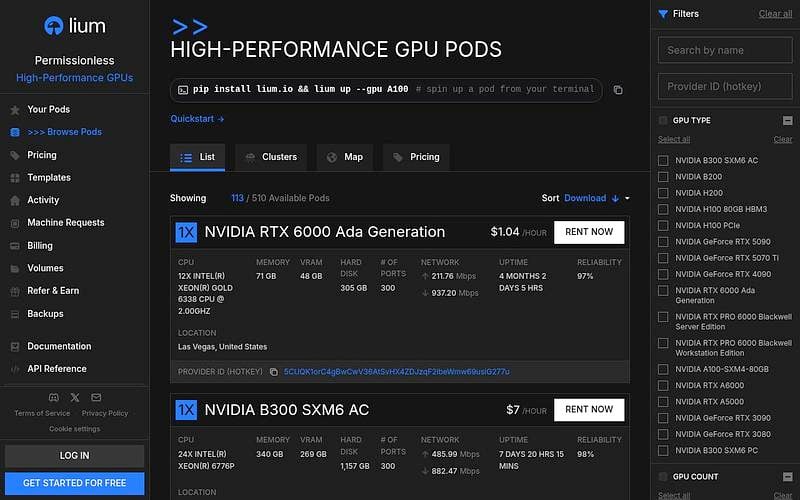
A pod is a Docker container on the provider's machine, started from a template (PyTorch with CUDA by default, or a custom image) and reached over SSH. Each listing shows the GPU, CPU, RAM, disk, network speed, uptime, reliability score and location. Machines on a shared RDMA fabric can be rented together as a multi-node cluster over InfiniBand or RoCE for distributed training. Volumes backed by S3-compatible storage mount at /mnt and outlive the pod. Scheduled backups and termination times are available too.
The whole path runs without a browser. The lium CLI covers signup, top-up, renting and teardown (lium up --gpu H100 --ttl 1h). The Python SDK's @lium.machine decorator runs a single function on a rented GPU and removes the pod afterwards. A REST API with an OpenAPI spec and a docs MCP server cover the rest. The CLI and the subnet code are MIT-licensed on GitHub.
Pricing and billing
Each provider sets its own hourly price per GPU. Pods are billed per second with no minimum: the platform charges the balance every five minutes and settles the remaining seconds when a pod is removed. Deploying needs a balance covering 15 minutes of the pod's price. New accounts may receive a small signup credit; it is not guaranteed. On 15 October 2026 (14:00 UTC) the live feed listed H100 80GB at a $1.39 reference price per GPU-hour and RTX 4090 at $0.30. Prices change through the day, so check lium.io/pricing.json for the current range per model, no key needed. Balances are topped up by card through Stripe, or with USDT, TAO or alpha. Volumes and backups are charged per GB-hour stored.
What to check before renting
Security depends on the machine. On a standard node the provider keeps host-level access and could read files, environment variables and memory inside the pod. Lium's terms forbid it and ban providers who do it. Its own docs still advise keeping API keys, private keys and proprietary weights off these pods. Confidential Computing nodes run pods inside an Intel TDX virtual machine the provider cannot read into. A pod can request an attestation quote to prove it. On most templates the pod's /root directory is an encrypted mount by default, while /workspace and some templates use plain disk.
Nodes marked Spot can be interrupted without compensation; the default Secure tier penalises providers who interrupt a rental. Location varies by listing: of 43 available nodes on 15 October 2026, 24 were in the US, with the rest spread across Europe, Australia and Canada. Access is blocked from US-embargoed countries and for sanctioned parties.
Frequently Asked Questions
How much does Lium cost?
Each provider sets its own price per GPU-hour. Pods are billed per second with no minimum rental. On 15 October 2026 (14:00 UTC) the live price feed listed H100 80GB at a $1.39 reference price per GPU-hour and RTX 4090 at $0.30. Prices change through the day; current ranges for every model are published at lium.io/pricing.json.
Does Lium have a free tier?
There is no free tier. New accounts may receive a small signup credit; it is not guaranteed. Renting runs on a prepaid balance: deploying a pod needs enough to cover at least 15 minutes of its hourly price. Billing is per second, so a short test run costs cents rather than a full hour.
Is my data safe on a rented Lium GPU?
It depends on the node. On a standard node the GPU provider has host-level access, which Lium forbids them to use but cannot technically prevent. Lium's docs therefore advise keeping secrets and proprietary weights off those pods. Confidential Computing nodes run the pod inside an Intel TDX virtual machine the provider cannot read. They also support attestation.
Can an AI agent rent a GPU on Lium without a human?
Yes. The CLI can create an account, top up with USDT, rent a node with a time limit and remove it, all from a shell. The REST API and a docs MCP server cover the same ground for agents without one.
Where are Lium's GPUs located?
Wherever the providers are; each listing shows its country and region. Of 43 available nodes on 15 October 2026, 24 were in the US, with others in Europe, Australia and Canada.
Lium Alternatives
Explore 147 products in the Inference APIs category. View all Lium alternatives.

AiQu
Swedish GPU infrastructure and LLM hosting platform with API-first deployment, no Kubernetes required



Aurora Inference
OpenAI-compatible API for open-weight models, with in-region deployment on reserved capacity


TypeSafe Jev
Hosted decision model that returns typed choices, scores and yes/no answers with calibrated confidence.
Is your product missing?